Cold Fermentation
The slowest path to the best dough — less yeast, more time, and a cold fridge transform simple flour and water into complex, deeply flavored bread and pizza crust.
What It Is
Cold fermentation (also called cold retarding or cold proofing) is the practice of fermenting dough in the refrigerator at 38–42°F for an extended period — typically 24 to 72 hours — using a fraction of the yeast a same-day recipe would call for. The cold temperature slows yeast activity dramatically but doesn’t stop it, and more importantly, it allows enzymatic processes to work on the flour’s starches and proteins over an extended timeline. The result is dough with deeper flavor, better browning, improved texture, and easier handling than anything a same-day recipe can produce.
Every acclaimed pizza and bread authority — from Ken Forkish to Tony Gemignani to Dan Richer — converges on some version of this principle: less yeast, more time, maximum heat.
Why It Works
Several things happen simultaneously during a long, cold ferment that don’t have time to occur in a same-day dough:
Enzymatic sugar production. Amylase enzymes in the flour slowly break down complex starches into simple sugars — maltose, glucose, fructose. These sugars serve dual purpose: they feed the yeast (keeping it alive over the long ferment) and they remain on the dough’s surface to fuel Maillard browning during baking. This is why long-fermented dough browns more deeply and evenly than same-day dough, even at the same oven temperature. Insufficient fermentation means fewer sugars available for browning, which is why quick doughs often bake pale and bland.
Flavor compound development. As yeast slowly metabolizes sugars, it produces organic acids (lactic and acetic), alcohols, and esters — the same compounds responsible for the complex flavors in sourdough, wine, and beer. A 72-hour cold ferment develops nutty, subtly tangy, slightly sweet notes that are completely absent in a 2-hour room-temperature rise. As Baking Steel puts it: “1 day is good, 2 days is even better, by day 3 the dough is LEGENDARY.”
Gluten development without kneading. Time replaces mechanical work. During cold fermentation, flour proteins (glutenin and gliadin) slowly hydrate, bond, and organize into a gluten network. After 24+ hours, the dough develops smooth, extensible gluten comparable to what 10 minutes of intensive kneading would produce — but with a more relaxed, open structure that creates bigger air pockets in the finished crust.
Improved handling. Cold dough is firmer and less sticky than room-temperature dough, making it easier to shape. When you pull it from the fridge and let it warm for 1.5–2 hours, it relaxes into a supple, stretchy state that’s a pleasure to work with.
The Schedule
The magic ratio: less yeast = longer ferment = better flavor. Here’s how yeast amounts correlate with timing for 500g of flour (instant dry yeast, baker’s percentage):
| Schedule | Yeast Amount | Character |
|---|---|---|
| Same-day (4–8 hrs at room temp) | 0.3–0.5% (~1.5–2.5g) | Acceptable, one-dimensional |
| 24-hour cold ferment | ~0.12% (~0.6g) | Good flavor development |
| 48-hour cold ferment | ~0.06% (~0.3g) | Excellent flavor |
| 72-hour cold ferment | ~0.04% (~0.2g) | Maximum flavor, best texture |
The practical rhythm that most home bakers and pizza operators use: mix Thursday evening, bake Saturday. This gives a full 48–72 hour window with minimal hands-on time — about 15 minutes total across 3 days.
How To Do It
-
Mix the dough with the reduced yeast amount. Combine flour, water, and yeast. Rest 20–30 minutes (autolyse — this lets flour hydrate passively). Add salt and any fat. Do 2–3 sets of stretch-and-folds over the next hour.
-
Divide and shape into balls or portions. Place in a lightly oiled container with space between pieces. Cover tightly with plastic wrap.
-
Refrigerate immediately. The dough ferments slowly in the cold, developing flavor and gluten over 24–72 hours.
-
Pull from the fridge 1.5–2 hours before use. The dough needs to reach 65–75°F for the gluten to relax. Cold dough snaps back and tears when you try to stretch it.
-
Shape and bake using whatever method your recipe calls for.
The Autolyse Step
Many cold-ferment recipes include an autolyse — mixing only flour and water, then resting 20–30 minutes before adding salt and yeast. This allows flour proteins to hydrate passively, beginning gluten formation without any kneading. Testing by Crust Kingdom found a 30-minute autolyse produced noticeably smoother dough, though a non-autolyse dough with 5 minutes of proper kneading performed comparably. For a minimal-effort cold-ferment workflow, autolyse is the easiest way to get smooth, extensible dough with almost zero physical work.
Common Mistakes
- Too much yeast — the most common error. Using a same-day yeast amount (1–2 teaspoons) with a 72-hour ferment produces over-proofed, sour, collapsed dough. A 72-hour ferment needs a tiny fraction — often less than ¼ teaspoon for a full batch.
- Not enough time — a 12-hour overnight ferment is better than same-day, but the real magic happens at 48–72 hours. Don’t shortcut it.
- Dough too warm going in — if the dough is already warm and active when refrigerated, it can over-proof before the cold slows things down. Refrigerate promptly after shaping.
- Container too small — the dough still rises in the fridge, just slowly. Leave room for 50–75% expansion.
- Not letting it warm up — pulling cold dough straight from the fridge and trying to stretch it immediately results in tearing and snap-back. Give it 1.5–2 hours at room temperature.
- Going past 5 days — flavor peaks around day 3 and begins to degrade after day 4–5. The dough loses vibrancy and can develop off-flavors from excessive acid production.
Why It Helps Browning
This connects directly to the Maillard reaction. Long fermentation produces free amino acids (from protein breakdown) and simple sugars (from starch breakdown) — the exact two reactants the Maillard reaction needs. A 72-hour dough has significantly more of both on its surface than a same-day dough. Combined with high oven heat, this produces the deep golden-brown, blistered, complex-flavored crust that separates great pizza from ordinary pizza. Adding diastatic malt powder amplifies this further — its active enzymes continue producing sugars throughout the entire ferment.
Related Techniques
Recipes Using This Technique
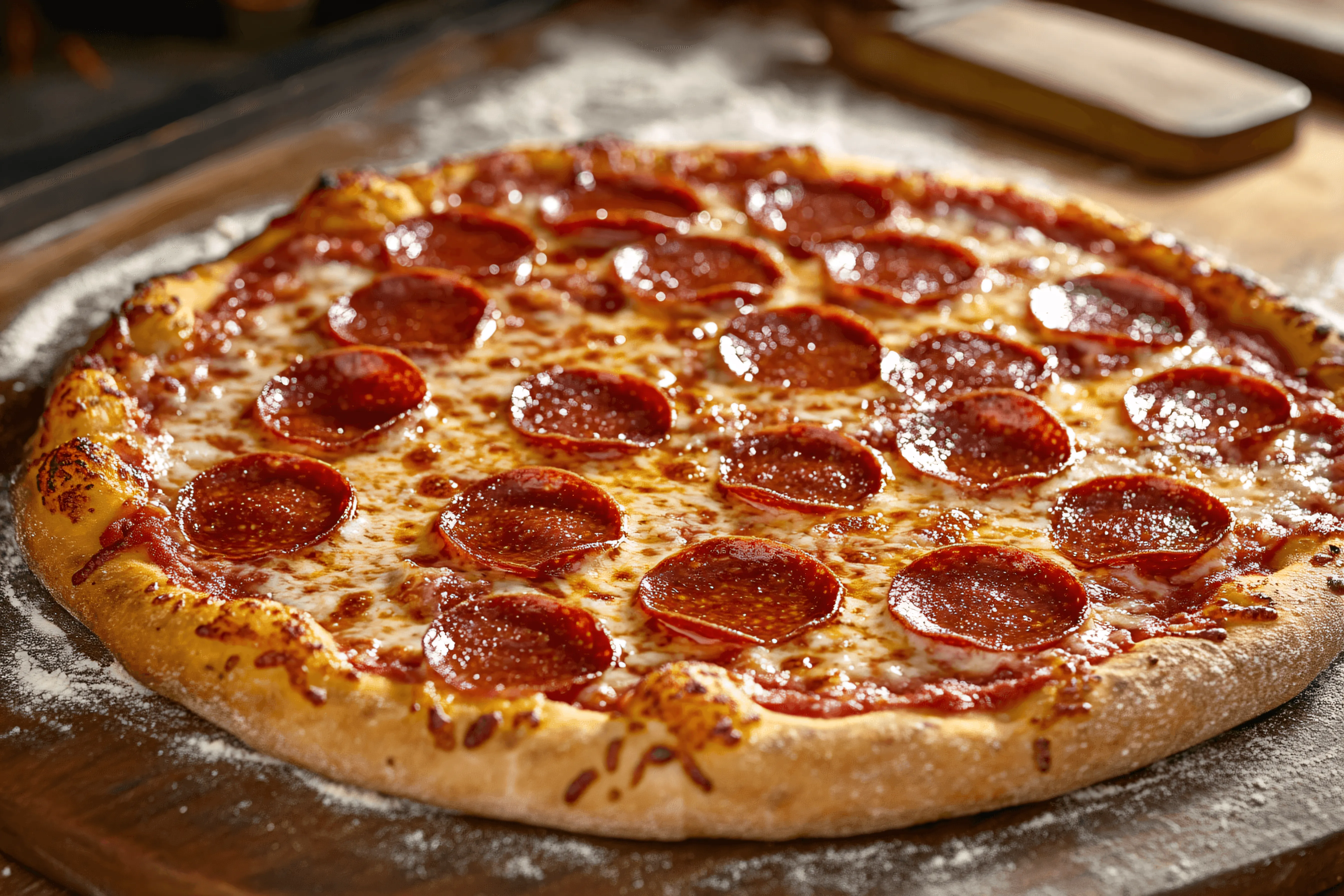
Minessale's Pizza
Neo-Neapolitan hybrid — 72-hour cold-fermented malt dough, raw crushed tomato sauce, a hidden Parmigiano layer under the mozzarella, baked on steel under a broiler.
Minessale's Pizza (Gluten-Free)
The GF variant — Caputo Fioreglut dough at 80% hydration, 72-hour cold ferment, par-baked on steel, same hidden Parmigiano layer and raw sauce.